SEO
What Are Local SEO Services? A Guide for Business Owners

Local SEO services help nearby customers find and contact you through Google Maps and search. They cover your business profile, website, listings and reviews.
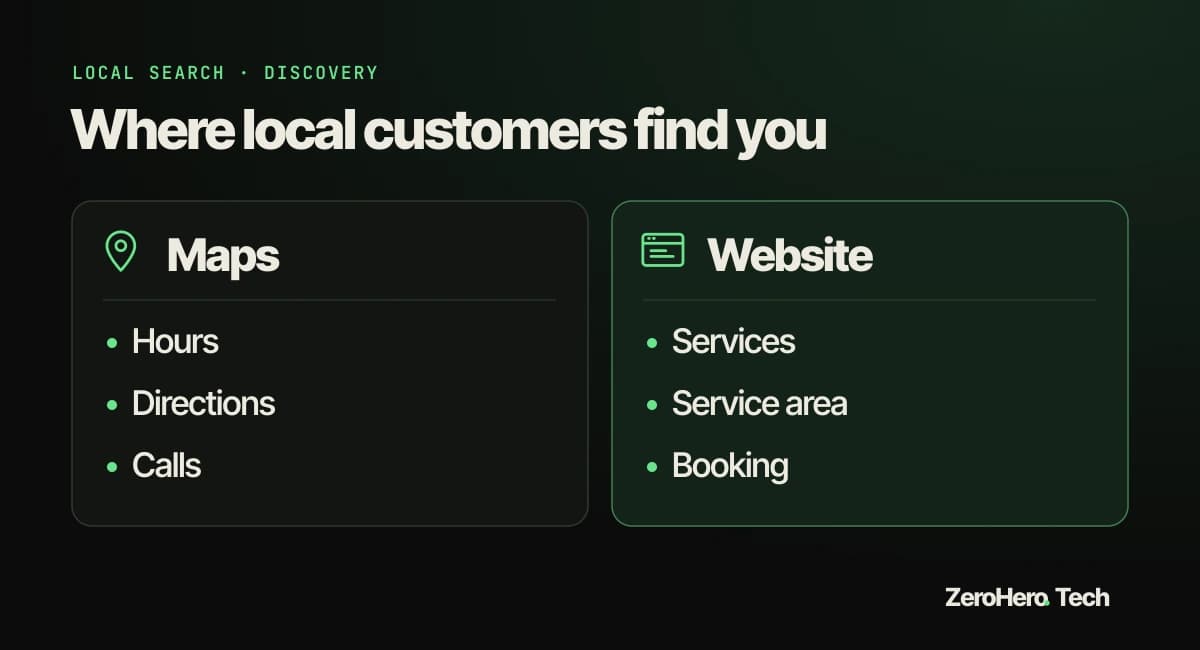
Where do customers find a local business?
Imagine a homeowner in Dartmouth with a leaking pipe. Searching for “plumber near me” on a phone might bring up a map with nearby plumbers, hours, reviews and a call button. Searching for “who repairs a leaking outdoor tap in Dartmouth” might bring them to a plumber’s service page. Both searches could lead to the same job. They give the customer different ways to decide whom to call.
Google describes three main factors behind its local results. Relevance is how well the business fits the search. Distance is how far it is from the searcher or the place they specified. Prominence reflects how well known it is and can be informed by links and reviews. That distance factor explains why two people searching from opposite sides of Halifax Harbour can see different results for the same words.
For Google’s own explanation, watch How to improve your local ranking on Google.
What do local SEO services include?
Packages vary. Use this table to turn a line such as “monthly local optimization” into work you can actually inspect. A single location that recently moved will have different priorities from a business opening its fourth branch.
| Service | What the provider does | What you can check |
|---|---|---|
| Google Business Profile | Reviews the business category, services, hours, phone number and website link. | Open the public profile on a phone. Can a customer reach the right person during the hours shown? |
| Service and location pages | Explains what you do, where it is available and how to arrange it. Connects each profile to the relevant page. | Follow the link for a specific branch. Check its hours, services and booking destination. |
| Listings and local citations | Finds old addresses, wrong phone numbers and duplicate listings in directories customers use. | Ask for the corrected listing URLs and a record of changes still waiting for approval. |
| Customer reviews | Sets up a neutral review request after a genuine visit or completed job and agrees who will reply. | Read the request. Every customer should have the same opportunity to give honest feedback. |
| Technical SEO | Checks whether search engines can index key pages and whether visitors can use the contact options on mobile. | Ask to see a fixed page, its indexing status and a completed test of its form or booking link. |
| Local links and mentions | Looks for legitimate references from partners, trade associations and community organizations. | Open a proposed source. Would one of your customers actually use it to find or verify a business? |
A citation is simply a mention of your business details on another site. An accurate entry in a directory your customers trust is useful even if it sends them straight to your phone. If your number changed recently, start with the listings that still send callers to the old one.
Which setup fits your business?
If customers visit you, make the visit easy to plan. A restaurant can publish dining hours, a current menu and an entrance description. A clinic can explain where to park and which appointments are available at that address. Check special hours before a holiday weekend, when a wrong listing can mean a wasted trip.
If you travel to customers, tell them which communities you serve and which jobs you accept. Under Google’s Business Profile guidelines, a service-area business that does not receive customers at its base should hide that address on its profile. A roofer working from home can still explain where the crew travels and how to request an estimate.
If you have several locations, give each eligible branch a useful destination. A Dartmouth page earns its place when it can answer something specific, such as which services are offered there or how to contact that team. If every paragraph stays true after swapping in another town name, consider one clear service-area page.
How precise should a service area be?
Google lets a service-area business list up to 20 service areas and advises keeping the outer boundary within roughly two hours’ drive of its base. Pick places your team actually serves. If a Dartmouth crew only takes jobs in Cole Harbour on certain days, its estimate page should explain that condition. After updating the profile, allow up to 48 hours for an approved service-area edit to appear, then check the public listing again.
A Dartmouth example from search to booking
Consider a fictional dental clinic that accepts new patients in Dartmouth. An existing patient searching the clinic’s name may just want Saturday hours. Someone searching “dentist accepting new patients in Dartmouth” still needs to decide whether to call. The receptionist knows what each caller asks. That makes the front desk a good place to start the audit.
Suppose the profile has the right hours, but its website button leads to a general homepage. The site mentions new patients only inside a downloadable form. The first useful change would be a visible new-patient page explaining how to request a visit, which location to choose and what happens after submitting. The team could then link to it from the relevant service page and test the booking route on a phone.
At the next review, the owner can ask two separate questions. Did people reach that page through local searches? Did the clinic receive suitable appointment requests? A rise in the first number with no movement in the second is a reason to inspect the booking process before commissioning another page.
What should a local SEO report measure?
Start with the outcome your business can confirm. For a contractor it might be an estimate for a job inside the service area. For a clinic it might be a booked appointment. Work backwards from that outcome when deciding what to measure.
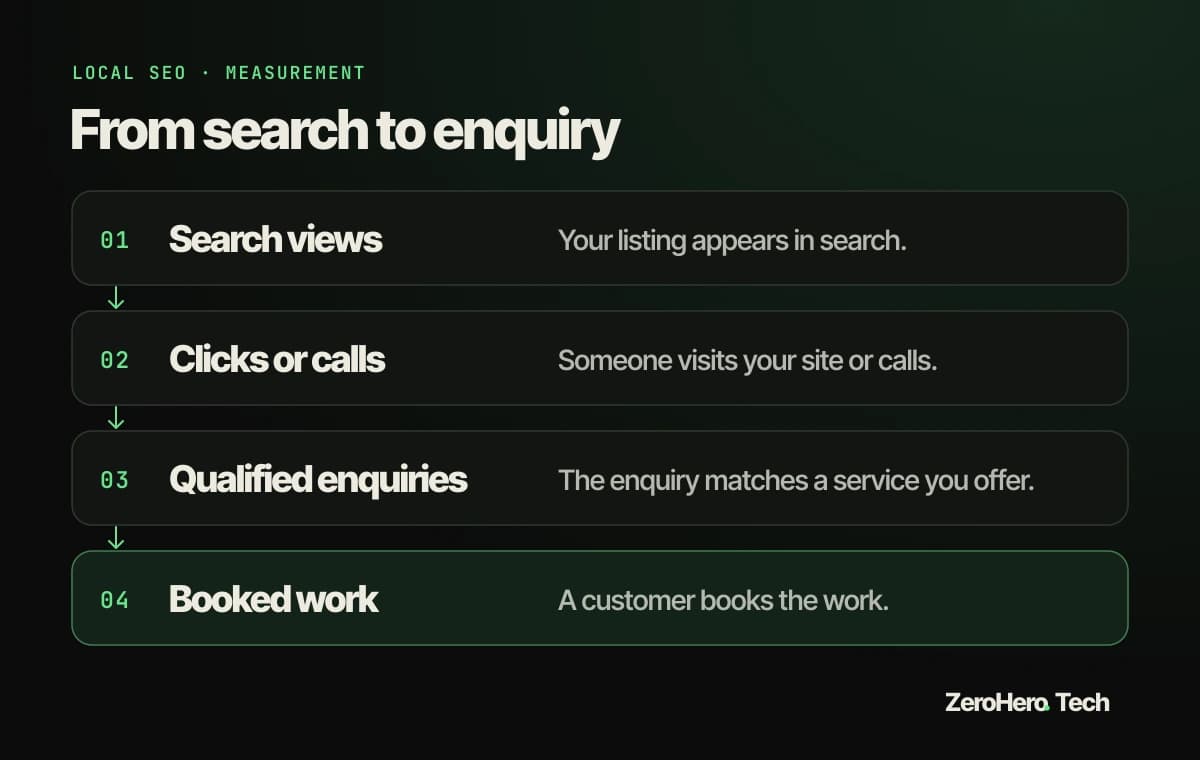
| Question | Where to look | How to interpret it |
|---|---|---|
| Did searchers see the website? | Google Search Console impressions by page and query. | Separate searches for your business name from searches for the services you offer. |
| Did they act on the profile? | Google Business Profile performance shows call-button taps, website clicks and direction requests where available. | A tap can go unanswered. A direction request does not confirm a visit. Profile performance can include Google Ads activity. |
| Was the enquiry a good fit? | Forms, booking requests and the team’s call or enquiry log. | Record the requested service and area. Exclude spam, duplicate requests and jobs you cannot take. |
| Did it become paid work? | Your booking calendar, sales records or invoicing system. | Connect the booking to its enquiry when possible. Leave the source unknown when you cannot verify it. |
Compare the same location, service and time period. Note changes such as a temporary closure, a new ad campaign or the start of a busy season. Those details help an owner interpret a trend before deciding what to fund next.
Local SEO and AI answers
Ask a question that usually comes to your front desk, such as “Which clinic in Dartmouth accepts new patients on Saturday?” Record the exact wording, tool, date and location. Check the appointment link, service and hours against what your team can actually book. Then open any source the answer cites. A stale directory listing and an inaccurate page on your own website need different fixes.
Google says a page must be indexed and eligible for a search snippet to appear as a supporting link in AI Overviews or AI Mode. Its usual search requirements apply. For your next check, keep the wording and location the same, then record both the answer and any cited page. Count a mention, a visit and a booked appointment separately. Our Halifax AI visibility check shows how to test a service in individual communities across HRM.
How much do local SEO services cost in Halifax?
ZeroHero Tech’s Local Foundation plan starts at CA$900 per month plus tax for a single-location business. That is our published starting price. A quote depends on how many locations need work, the condition of the site and who will make the fixes. Our Halifax SEO pricing guide explains the cost drivers and shows monthly prices with HST.
When comparing proposals, pick one real problem and ask every provider how they would handle it. If an old address still appears online, for instance, ask which listings they would fix, who needs to grant access and how you will know the corrections went live. You can compare our local SEO plans and monthly deliverables on those same terms.
What to ask before hiring a local SEO provider
- What would you fix first and why? Ask them to show one issue on your actual profile or website and explain what a customer experiences because of it.
- Who makes the changes? Agree on which updates the provider ships, which need your approval and which require your developer. Keep ownership of your profile, website and reporting accounts.
- What continues after the initial cleanup? Ask how they handle holiday hours, new services and incorrect listings that reappear. Get the agreed scope in writing.
- What will we decide from the report? A useful monthly review ends with a decision, such as fixing a broken booking link, improving a service page or leaving a well-performing location alone.
Frequently asked questions
How is local SEO different from regular SEO?
Both improve how people find your business in unpaid search. Local SEO also addresses your physical location or service area, your business profile, map results and the details a nearby customer needs before visiting or calling.
Can I do local SEO myself?
Yes. Start by checking your profile on a phone, updating your hours, testing the website link and correcting your busiest listings. A provider can help when you have several branches, persistent technical problems or too little time to keep the details current.
Does every town I serve need its own page?
One service-area page can cover several towns when the service and booking process are the same. A separate page is useful when customers need different information, such as a branch address, local service availability or a different booking number.
How long does local SEO take?
You can verify a corrected phone number as soon as the change appears publicly. Discovering a trend in calls or bookings takes longer and depends on demand, competition and how many enquiries you receive. Agree on a baseline and review comparable periods.
Can an agency guarantee a top spot on Google Maps?
No. Local results vary by search and location, and Google says businesses cannot pay for better local ranking. Ask a provider to commit to specific work and reporting you can verify.
Sources
- Google Business Profile Help, Manage service areas for service-area and hybrid businesses
- Google Search Central, AI features and your website
- Google Business Profile Help, Tips to improve your local ranking on Google
- Google Business Profile Help, Guidelines for representing your business on Google
- Google Business Profile Help, Tips to get more reviews
- Google Business Profile Help, Understand your Business Profile performance
- Google Search Console Help, Performance report for Search results