AI search
Why ChatGPT Recommends Your Competitor (and Not You): 7 Reasons

Your competitor shows up in ChatGPT and you don't? Here are the 7 most common reasons, how to test it yourself, and a fix plan for Canadian businesses.
You ask ChatGPT for "the best dentist in Halifax" or "a good plumber in Dartmouth," and it names three businesses. One of them is your competitor. You are not on the list.
It feels random, but it usually isn't. AI tools can only recommend what they can find, read and trust. When a competitor keeps getting named, it almost always means the web has clearer, more consistent and better-supported information about them than about you.
This guide covers the seven most common reasons, how to test where you stand in 15 minutes, and what to fix first.
How ChatGPT decides which business to recommend
When someone asks for a local recommendation, ChatGPT's search features can look things up on the web in real time. OpenAI uses its own crawler, OAI-SearchBot, to surface websites in ChatGPT search, and says that sites that block it will not be shown in ChatGPT search answers. Google works on a similar idea for AI Overviews and AI Mode: a page has to be indexed and eligible to appear in Google Search before it can be used as a supporting link.
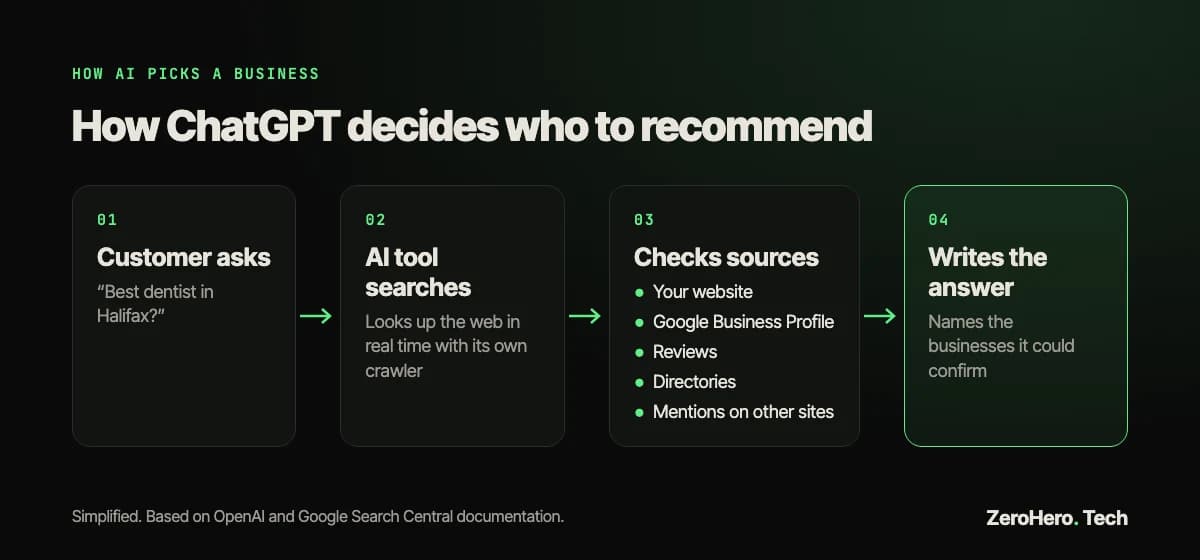
In practice, an AI answer is a summary of what the tool could find and confirm. The more sources agree about a business, and the more clearly those sources answer the question, the more likely that business is to be named.
That gives us the seven reasons.
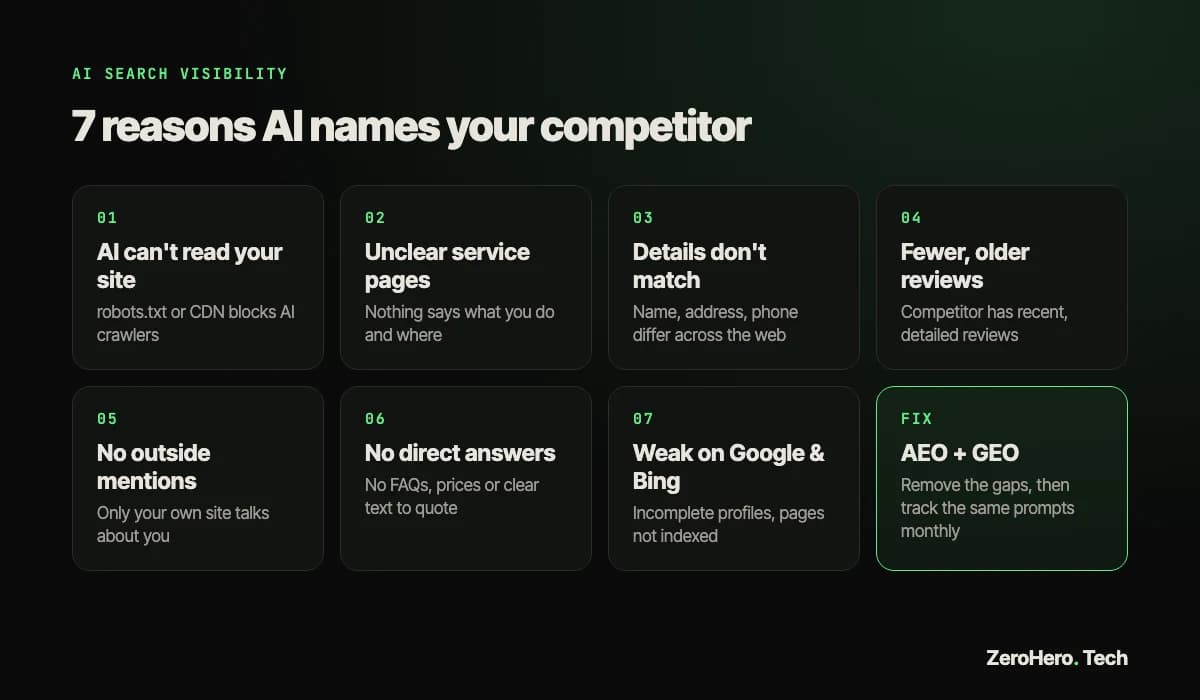
1. AI tools can't read your website
This is the most common problem and the easiest to miss, because your site looks completely normal to people.
AI companies use their own crawlers, and your website can block them without you knowing:
- robots.txt rules. A line added by a developer or a plugin can block AI crawlers. OpenAI treats its bots separately: OAI-SearchBot is for search, GPTBot is for model training. You can allow search and still block training.
- CDN and firewall settings. Since July 1, 2025, Cloudflare blocks AI crawlers by default for new domains, and many existing sites switched the same setting on. If your site runs through Cloudflare, check its AI crawler settings.
- Content that only loads with JavaScript or sits behind a login, pop-up or cookie wall can be invisible to crawlers.
A competitor on a simple, open website may be readable while yours is not.
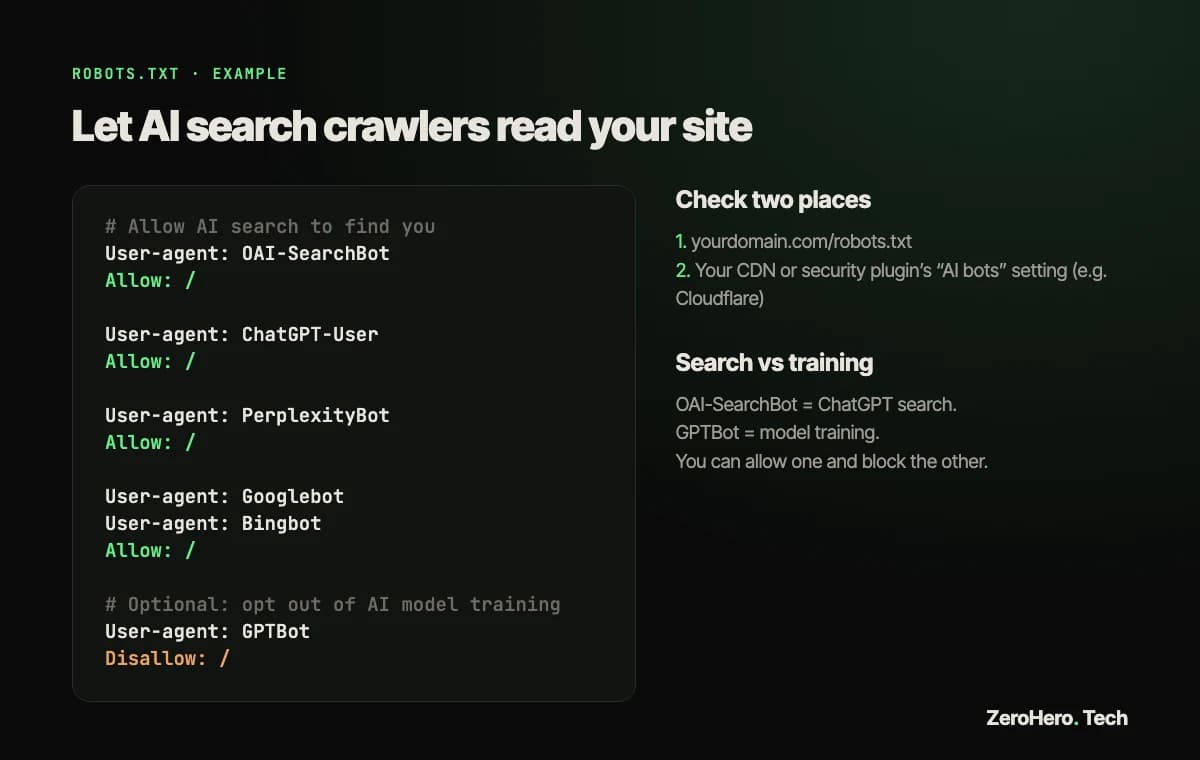
How to fix it: open yourdomain.com/robots.txt and look for Disallow rules under OAI-SearchBot, ChatGPT-User, PerplexityBot or a blanket User-agent: *. Then check your CDN or security plugin for an "AI bots" or "AI crawlers" setting. OpenAI says robots.txt changes take about 24 hours to reach its search systems.
2. Your website doesn't clearly say what you do and where
AI tools answer specific questions: "Who does emergency plumbing in Bedford?" "Which clinic offers Invisalign in Halifax?" If your homepage says "Quality solutions for your needs" and you have one general Services page, there is nothing specific to match.
Your competitor might have:
- A separate page for each main service, with the service name in the title and heading.
- The city and areas they serve written in plain text.
- Who the service is for, what it costs or what affects the price, and how to book.
How to fix it: give every important service its own page, and name the city and service areas in plain language. Write the opening paragraph so it could be quoted as an answer on its own: who you are, what you do, where, and for whom.
3. Your business details don't match across the web
If your website says "Suite 200," Google says "Unit 2," an old directory still has your previous phone number and Facebook uses a different business name, AI tools have to decide which version is true. When the facts don't line up, the safest choice for the AI is to recommend someone whose facts do.
| Detail | What to check | Where it usually goes wrong |
|---|---|---|
| Business name | Exactly the same everywhere | Old trading names, extra keywords added to the name |
| Address | Same format, same unit number | Old locations, "Suite" vs "Unit" |
| Phone | One main number | Old numbers on directories, tracking numbers |
| Hours | Same on site and profiles | Holiday hours not updated |
| Services | Same list and names | Website updated, profiles never touched |
| Website URL | Current, https, no old domain | Old domain still listed on directories |
How to fix it: pick one official version of each detail, update your website, Google Business Profile, Bing Places, Apple Business Connect, Facebook and the main directories in your industry. Add LocalBusiness structured data to your website so machines can read your details directly.
4. Your competitor has more recent, detailed reviews
Reviews matter for two reasons. Google says that the number of reviews and positive ratings can help local ranking, and Google's results feed its AI features. AI tools also read what reviews say. "They fixed our furnace on a Sunday in Dartmouth" tells an AI far more than "Great service!"
| Your competitor | You |
|---|---|
| Steady new reviews every month | A burst of reviews two years ago |
| Reviews mention services and neighbourhoods | Short one-line reviews |
| The owner replies to most reviews | Reviews left unanswered |
| Reviews on Google and one or two industry sites | Reviews on Google only, or nowhere |
How to fix it: ask every happy customer, as part of your normal process, with a direct link. Don't script the wording, but it's fine to say "it helps if you mention what we did for you." Reply to every review. Never buy reviews or offer rewards for them, which breaks platform rules and can get reviews removed.
5. Nobody else on the web talks about you
AI tools prefer recommendations they can confirm from more than one place. If your competitor appears in a "best of" list, a local news story, a supplier's case study, a chamber of commerce directory and an industry association, the AI has several independent sources saying the same thing. If the only source about you is your own website, it has one.
Mentions that tend to help:
- Local "best of" lists and comparison articles in your city.
- Industry associations and professional directories.
- Chambers of commerce and business improvement districts.
- Local news, podcasts and community sponsorships.
- Partners and suppliers that list you on their sites.
- Reddit and forum threads where real customers recommend you (earned, not posted by you).
How to fix it: make a list of the sites that already mention your competitor (searching their business name is a good start), then work through the ones you can genuinely earn: memberships, sponsorships, partner pages, and being useful to local journalists.
6. Your pages don't answer questions directly
AI answers are built from clear, quotable text. A page that hides its prices in a PDF, uses vague marketing language or never answers common questions is hard to use as a source.
| Hard for AI to use | Easy for AI to use |
|---|---|
| "Contact us for pricing" with no context | "Most projects cost $X to $Y. Here's what changes the price" |
| One long block of text | Clear headings, short paragraphs, lists and tables |
| Service details only in images or PDFs | Details in plain text on the page |
| No FAQ | Real customer questions answered in 2 to 3 sentences |
| No structured data | LocalBusiness, Service and FAQPage schema |
How to fix it: for each service page, list the 5 to 8 questions customers ask you on the phone, and answer them on the page in plain language. Add FAQPage structured data for those answers.
7. You're weak on Google and Bing, where AI tools look first
AI answers don't come from nowhere. Google says the same SEO best practices apply to AI Overviews and AI Mode, with no special extra requirements. Microsoft's Copilot is built on Bing. If your business doesn't rank, isn't indexed or has an incomplete profile on these search engines, AI tools that rely on them have less to work with.
Many businesses have never claimed Bing Places or verified their site in Bing Webmaster Tools, while their competitor has.
How to fix it:
- Complete your Google Business Profile: categories, services, hours, photos, description, and regular updates.
- Claim Bing Places and add your site to Bing Webmaster Tools.
- Make sure your important pages are indexed (check Google Search Console's page indexing report).
- Keep doing the SEO basics: fast pages, clear titles, internal links. Whether you need local SEO in Halifax or SEO services across Canada, good SEO is still the foundation of AI visibility.
What a real AI mention looks like
Search for a company by name and you can learn whether the tool identifies the right business. In this saved Google result for the single word “mivee”, the AI Overview lists several possible meanings. It describes Mivee App as a calorie and protein tracker and displays a source card for mivee.app alongside the answer.
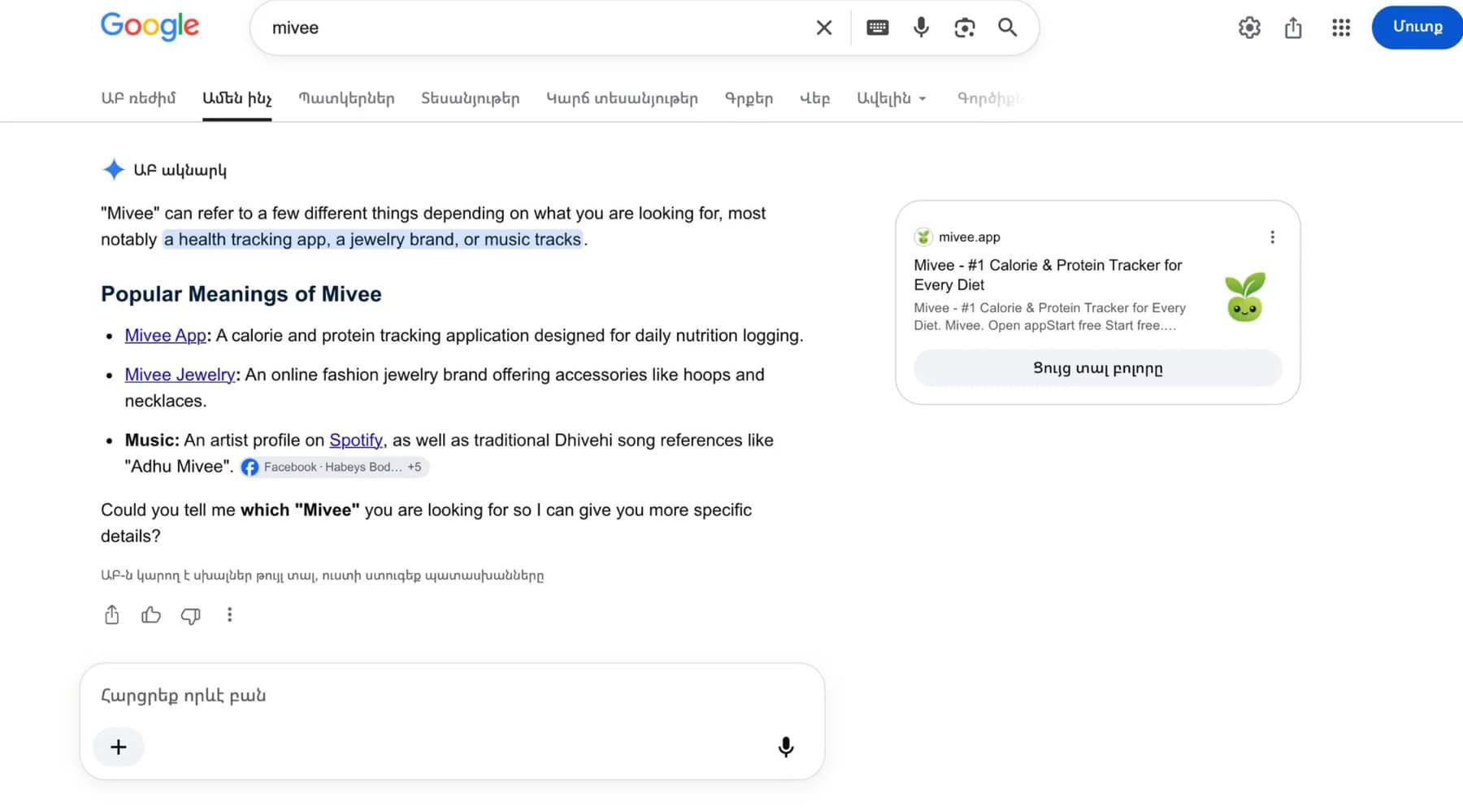
If the question changes to “which app should I use to track protein?”, repeat the test and save that answer separately. The branded screenshot establishes what appeared for one search. It cannot tell us which app a new customer will hear about, or whether that person installed it.
How often do people follow the sources?
Pew Research Center analysed Google searches made by a panel of US adults in March 2025. An AI summary appeared for 18% of the searches in the study. A traditional result received a click on 8% of visits with a summary and 15% of visits without one. On visits with a summary, a link inside the summary itself received a click just 1% of the time.
These figures describe US Google browsing in that study. To understand a Canadian business on ChatGPT, record the mentions you actually observe there. Track visits and enquiries separately. If an answer names your business but links to an outdated directory, the first fix may be as simple as correcting the phone number a customer sees next.
How to check where you stand in 15 minutes
You don't need special tools to get a first picture. Do this:
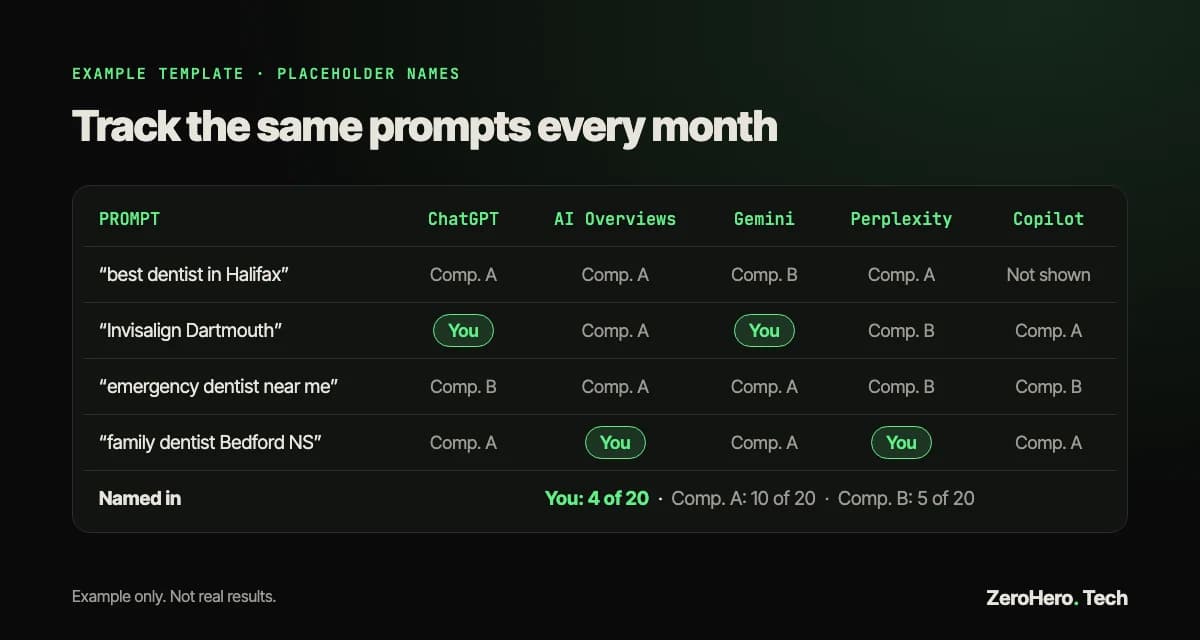
- Write 5 to 10 real questions a customer would ask, with your city: "best [service] in Halifax," "who does [service] near Dartmouth," "[service] for small businesses in Nova Scotia."
- Ask each one in ChatGPT, Google (look for an AI Overview), Gemini, Perplexity and Copilot. Use a private window and, where you can, log out, so results aren't shaped by your own history.
- Write down who gets named and which sources are linked. The sources tell you where the AI is getting its information.
- Repeat with the same prompts every month. One answer means little. A trend over three months means a lot.
If you serve a bilingual market, test in French as well as English. Answers can be different.
What to fix first
Not every gap takes the same effort. Start with what blocks you completely, then build what earns trust.
| Priority | Fix | Effort | Why first |
|---|---|---|---|
| 1 | Unblock AI crawlers (robots.txt, CDN settings) | Low | If AI can't read your site, nothing else matters |
| 2 | Make business details match everywhere | Low to medium | Removes conflicting facts |
| 3 | Complete Google Business Profile and Bing Places | Low to medium | Feeds the search engines AI tools rely on |
| 4 | Clear service and location pages with FAQs | Medium | Gives AI something specific to quote |
| 5 | Steady review requests and replies | Ongoing | Builds trust over time |
| 6 | Earn mentions on other trusted sites | Ongoing | Confirms you from independent sources |
| 7 | Track the same prompts every month | Ongoing | Shows what's working |
Items 1 to 3 can often be done in a few weeks. Items 4 to 7 are where most of the long-term difference comes from, and they overlap almost completely with good local SEO. If your website itself is the problem, a rebuild with clear service pages may be the faster route. Our web design team in Halifax builds sites with this structure from day one.
Choose the right market for the test
A restaurant testing AI visibility in Halifax can compare pickup in Dartmouth with delivery in Bedford. A clinic testing AI answers in Toronto can check the booking link for each branch. A home service business testing recommendations in Metro Vancouver can compare a neighbourhood it serves with one outside its coverage. Use questions a customer could act on and check the address or service area in the answer.
When to get help
You can do most of this yourself if you have the time. It makes sense to bring in help when:
- You've fixed the basics and still don't show up after a few months.
- You have several locations or services and the work is multiplying.
- You need someone to track prompts across ChatGPT, Google AI Overviews, Gemini and Perplexity every month and turn the results into a plan.
That is what our AEO and GEO services do: a free first check of how your business shows up in AI answers today, a baseline report of the prompts and sources that matter in your market, the fixes, and monthly tracking. For businesses that also need classic search work, it is included in our SEO plans from CA$900/mo plus tax. If you want to understand the basics first, our guide on writing SEO-friendly content with ChatGPT is a good next read.
We don't promise placement in any AI answer. Nobody can. We remove the reasons you're being left out, and we show you every month what changed.
Frequently asked questions
Why does ChatGPT recommend my competitor and not my business?
Usually because AI tools can find more clear, consistent and trusted information about your competitor: a site they can crawl, service pages that answer the question, reviews, and mentions on other websites. It is rarely one thing. Most businesses have two or three of the gaps in this guide at once.
Can I pay ChatGPT to recommend my business?
No. There is no paid placement inside ChatGPT's normal answers. You influence recommendations the same way you influence search: by making accurate information about your business easy to find, read and confirm.
How long does it take to start showing up in AI answers?
Technical fixes like unblocking AI crawlers can take effect quickly. OpenAI says robots.txt changes take about 24 hours to reach its search systems. Reviews, mentions and content take longer, usually a few months of steady work.
Is AEO different from SEO?
It builds on SEO. Google says the same SEO best practices apply to AI Overviews and AI Mode, with no special extra requirements. AEO and GEO add a focus on clear answers, consistent facts across the web and being mentioned by sources AI tools trust.
Does ChatGPT give everyone the same answer?
No. Answers change with the wording of the question, the location, the conversation so far and over time. That is why it is better to test the same set of prompts every month than to judge by one answer.
Do I need an llms.txt file?
It is optional. llms.txt is a proposed standard, not something any AI tool requires. It is cheap to add and can help, but it will not fix blocked crawlers, missing pages or a lack of reviews.
Can you guarantee my business will be recommended?
No, and nobody honestly can. AI tools decide their own answers. What we can do is remove the reasons you are being left out and track the same prompts every month so you can see what changes.
Find out why AI is skipping your business
Send us your website and the questions your customers ask. We'll run a free manual check across ChatGPT, Google AI Overviews, Gemini and Perplexity and tell you which of these seven reasons apply to you. Get your free AI visibility check.
Sources
- Pew Research Center, Google searches, AI summaries and link clicks in the United States (July 2025)
- OpenAI: Overview of OpenAI Crawlers (OAI-SearchBot, GPTBot, ChatGPT-User)
- Google Search Central: AI features and your website (AI Overviews and AI Mode)
- Google Business Profile Help: Tips to improve your local ranking on Google
- Cloudflare: Content Independence Day, AI crawlers blocked by default (July 1, 2025)
- Bing Webmaster Tools: Which crawlers does Bing use?
- llms.txt: proposal by Jeremy Howard (September 2024)
- Schema.org: LocalBusiness